DwarfLab Dwarf 3
DwarfLab's compact refractor, sensor, filters and mount compared
At a glance
Clear night6.7 out of 10
The Dwarf 3 combines a wide 3° field of view with a 1.35 kg body and 5.5 hours of battery life, according to the maker. Its 35 mm (1.4 in) aperture gathers less light than most of the telescopes compared.
Five scores, from 1 to 10
- Light graspaperture, against every scope listed here2.7
- Field of viewhow much sky fits in one frame7.8
- Portabilitycarry weight, without the tripod8.5
- Easebattery, autofocus, dew heater, light pollution handling7.8
Mean score 6.7 out of 10
The sums behind these figures are set out on how scores work. With no figure from the maker, a row stays empty.
Compared with Unistellar
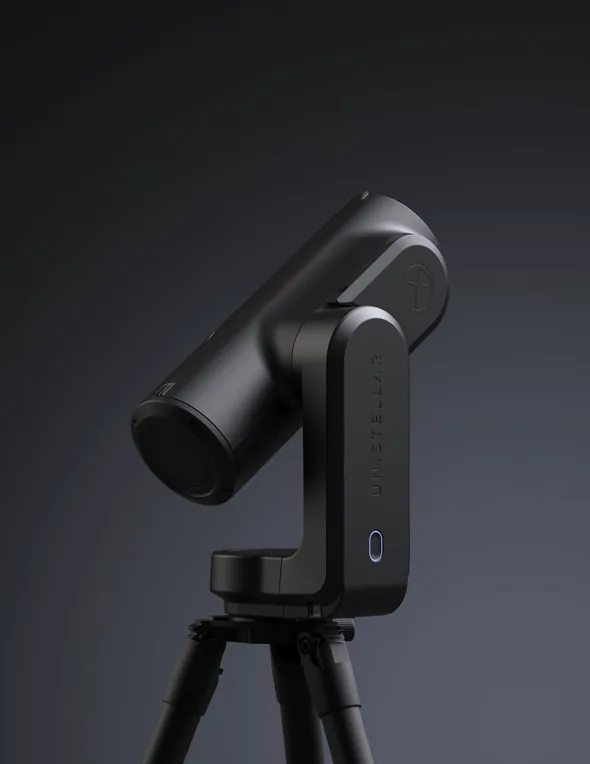 Unistellar Odyssey
£2,099Price at Unistellar's UK shop, 23 October 2026
| Spec | DwarfLab Dwarf 3 | Unistellar Odyssey |
|---|---|---|
| Aperture | 35 mm | 85 mm |
| Weight | 1.35 kg | 4 kg |
| Battery life (maker's figure) | 5.5 h | 5 h |
Dwarf 3 specifications and observing setup
The 35 mm (1.4 in) aperture makes the Dwarf 3 a small refractor among the smart telescopes compared. Its aperture gathers less light than most of them, a trade-off to weigh against its 1.35 kg body weight and wide field.
The Sony IMX678 Starvis 2 image sensor records 8.3 MP. That sensor specification, rather than an eyepiece view, defines the Dwarf 3 as an app-controlled smart telescope with a built-in camera sensor. The DWARFLAB app provides the control interface.
The 3° field of view covers a wider patch of sky than most of the telescopes compared. That broad framing is relevant when selecting targets and composing an image, while the aperture remains smaller than most in this comparison.
The alt-azimuth mount also has an equatorial mode. This gives you a choice of mount mode when setting up, without changing the stated aperture, sensor or field of view.
Filters, battery and carrying weight
The built-in filters are VIS (430-650 nm), Astro (440-690 nm) and dual-band OIII 500.7 nm + Ha 656.3 nm. The dual-band filter is a light pollution filter for emission-nebula imaging under a bright town sky; the wavelengths identify the bands it passes, without promising a particular result.
The battery life is 5.5 hours, according to the maker. That quoted duration sets the stated operating window between charges, so your session plan can take it into account.
The body weight is 1.35 kg, according to the maker, with the tripod excluded. That makes the telescope lighter to carry out than most of the telescopes compared, though the figure applies to the body rather than a complete setup.
The IP54 weather resistance rating gives the Dwarf 3 a stated level of protection against dust and water ingress. It is a rating, not a claim that weather or dew has no bearing on where you set up.
See it at DwarfLabDwarfLab Dwarf 3, from £459, Typical UK retail price, 23 October 2026
Where it sits among the telescopes compared
Light grasp: lower than most.
Field: wider than most.
Portability: lighter than most.
Ease: mid-ranking (the comparison averages battery life and the hands-off features named for this line, including 5.5 hours of battery life and a built-in light pollution filter).
Its wide field, low body weight and built-in filter sit alongside a smaller aperture than most of the telescopes compared.
Specifications
| Optical design | Refractor |
|---|---|
| Aperture | 35 mm (1.4 in) |
| Focal length | not stated by the maker |
| Focal ratio | not stated by the maker |
| Sensor | Sony IMX678 Starvis 2, 8.3 MP |
| Pixel size | not stated by the maker |
| Image size | not stated by the maker |
| Field of view | 3° |
| Limiting magnitude (maker's figure) | not stated by the maker |
| Mount | Alt-azimuth, with an equatorial mode |
| Electronic eyepiece | not stated by the maker |
| Filters built in | VIS (430-650 nm), Astro (440-690 nm), dual-band OIII 500.7 nm + Ha 656.3 nm |
| Autofocus | not stated by the maker |
| Battery life (maker's figure) | 5.5 h |
| Weight | 1.35 kg |
| Storage | not stated by the maker |
| Dew heater | not stated by the maker |
| Weather rating | IP54 |
| App | DWARFLAB app |
Source: the maker's own specification sheet. Where it says "not stated by the maker", the maker has not given that figure so far.
Versions: 2 to choose from
Typical UK retail price, 23 October 2026. Each row leads to that version at the shop.
Strengths and limits
- The maker specifies a 35 mm (1.4 in) aperture and a Sony IMX678 Starvis 2 image sensor with 8.3 MP.
- According to the maker, the 3° field of view frames a wider patch of sky than most telescopes in the comparison.
- The maker states 5.5 hours of battery life, built-in VIS, Astro and dual-band filters, and IP54 weather resistance.
- According to the maker's comparison, the 35 mm (1.4 in) aperture gathers less light than most of the telescopes compared.
- The 1.35 kg weight applies to the body, with the tripod excluded, according to the maker.
Who it suits, and which skies
For first nightsFor town skiesGrab and go
A good match if you want a light smart telescope, a wide field of view or built-in filter options.
Less so if you prioritise a larger aperture or need the tripod included in the stated weight.
Bundles and prices for each version sit in the table above; the current line-up is on the shop's own page.
Questions about the DwarfLab Dwarf 3
- How much does the Dwarf 3 weigh to carry?
- The maker states a body weight of 1.35 kg, with the tripod excluded.
- How long does the battery last, and what filters are built in?
- According to the maker, battery life is 5.5 hours. The built-in filters are VIS (430-650 nm), Astro (440-690 nm) and dual-band OIII 500.7 nm + Ha 656.3 nm.
- Is the Dwarf 3 suited to a city sky?
- The maker lists a built-in Astro filter and a dual-band OIII 500.7 nm + Ha 656.3 nm filter. The aperture is 35 mm (1.4 in), according to the maker.
- What mount and app does it use?
- The maker specifies an alt-azimuth mount with an equatorial mode and the DWARFLAB app.
- How wide is its field of view, and what image sensor does it have?
- According to the maker, the field of view is 3°. The image sensor is a Sony IMX678 Starvis 2 with 8.3 MP.
Last light
The maker's figures make the Dwarf 3 a compact smart telescope with a wide field of view and 5.5 hours of stated battery life. Its built-in VIS, Astro and dual-band filters add options for different targets, while its 35 mm (1.4 in) aperture gathers less light than most of the compared telescopes. The alt-azimuth mount has an equatorial mode, and the body weighs 1.35 kg, excluding the tripod, according to the maker. These specifications suit you if carrying a light instrument matters more than aperture.
See it at DwarfLabfrom £459, Typical UK retail price, 23 October 2026
Field notes that mention it
Nearby in the sky: similar scopes
- ZWO Seestar S3030 mm, 1.65 kg, £419
- DwarfLab Dwarf mini30 mm, 0.84 kg, from £399
- ZWO Seestar S30 Pro30 mm, 1.65 kg, Tele: 4.6°; Wide: 63°, £649
- ZWO Seestar S50 Pro50 mm, 2.8 kg, Tele: 2.8° (Portrait); Wide: 63° (Portrait), £999