Smart telescopes under town skies (Bortle 7 and up)
From the middle of a British town you can count the stars of the Plough and not much else. A smart telescope can still bring back nebulae from that sky, as long as you match the instrument to what skyglow lets through.
What Bortle 7 means for a camera
The Bortle scale runs from 1, a truly dark site, to 9, an inner city. At 7 and above, the sky background is bright enough that it fills a sensor's pixels within seconds. Faint objects do not vanish, but they sit on top of a bright layer, and the noise in that layer hides them. Stacking more frames helps, slowly; removing the glow before it reaches the sensor helps faster, for some targets.
Nebulae and galaxies behave differently
Emission nebulae, such as the Orion Nebula or the Heart Nebula, shine at a few narrow wavelengths, chiefly hydrogen-alpha in the red and doubly ionised oxygen in the green. A dual-band filter passes those two lines and blocks most of the rest, including much of the glow from street lighting. Galaxies and star clusters shine across the whole spectrum, so a filter that blocks the glow also blocks them. Under a town sky, filters rescue nebulae; for galaxies, only aperture, time and a darker site help.
Three answers on the spec sheets
A physical filter
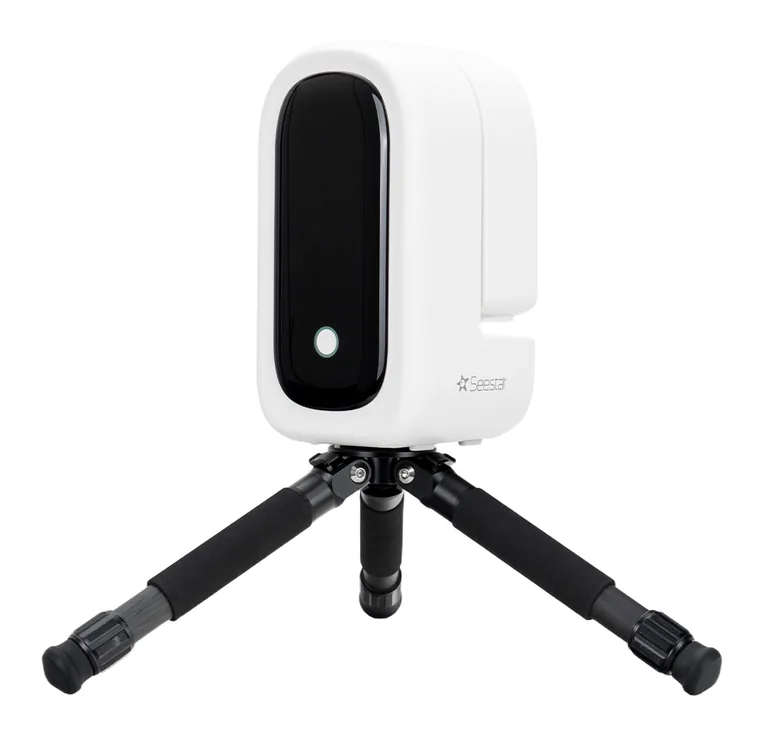
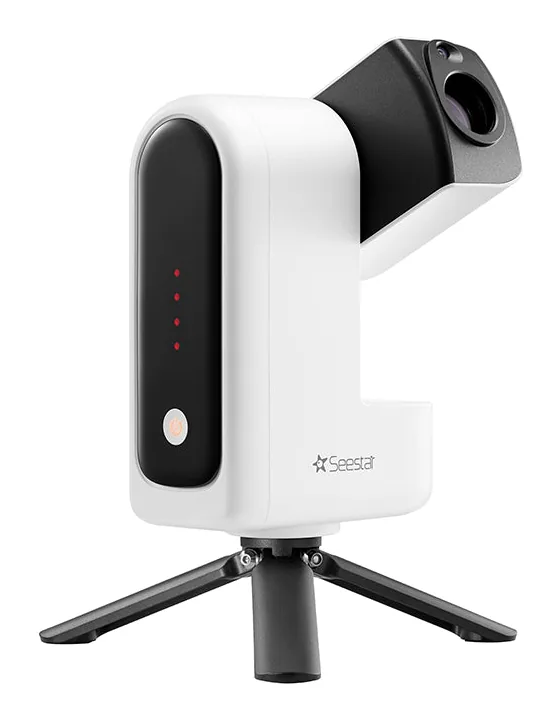
- Seestar S50 Pro and Seestar S30 Pro: a dual-band filter, OIII at 30 nm and H-alpha at 20 nm by ZWO's figures.
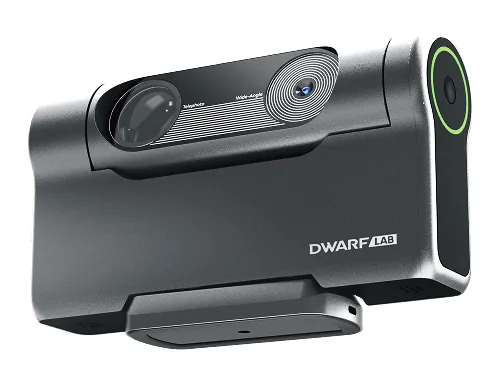
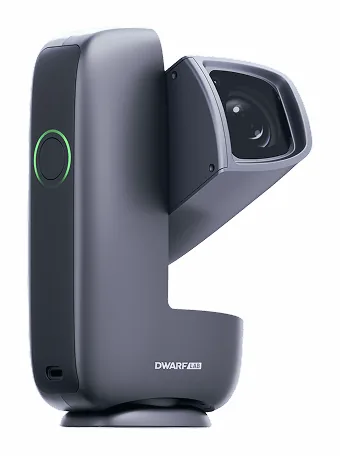
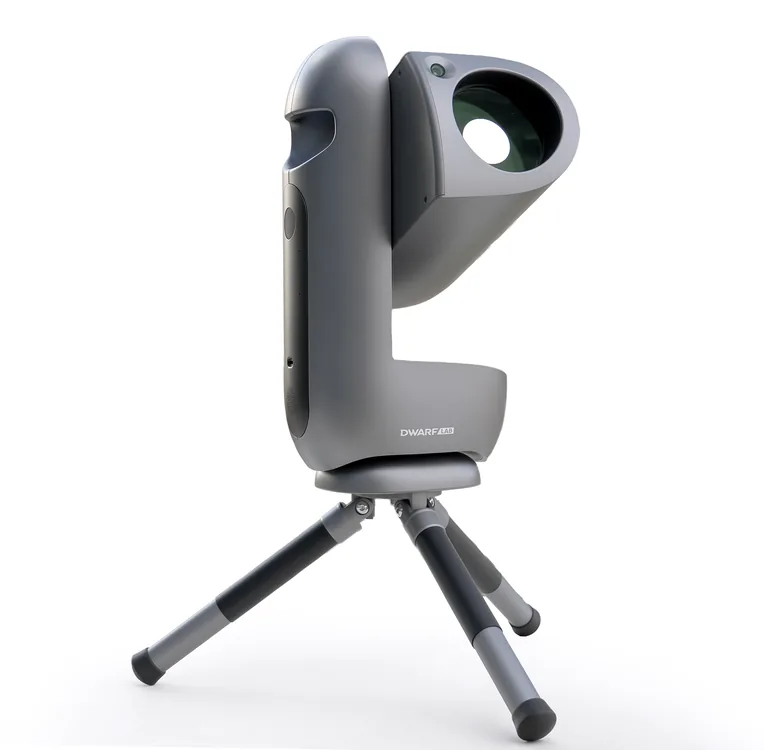
- Dwarf 3 and Dwarf mini: a dual-band filter for the same two lines, plus an astro filter.
- DwarfLab Draco: a dual narrowband filter of 13 nm (plus or minus 3) on each line, and an SHO Edition with a sulphur and oxygen pair.
The narrower the band, the more skyglow it rejects. The Draco's figure is the tightest on this list.
Processing in software
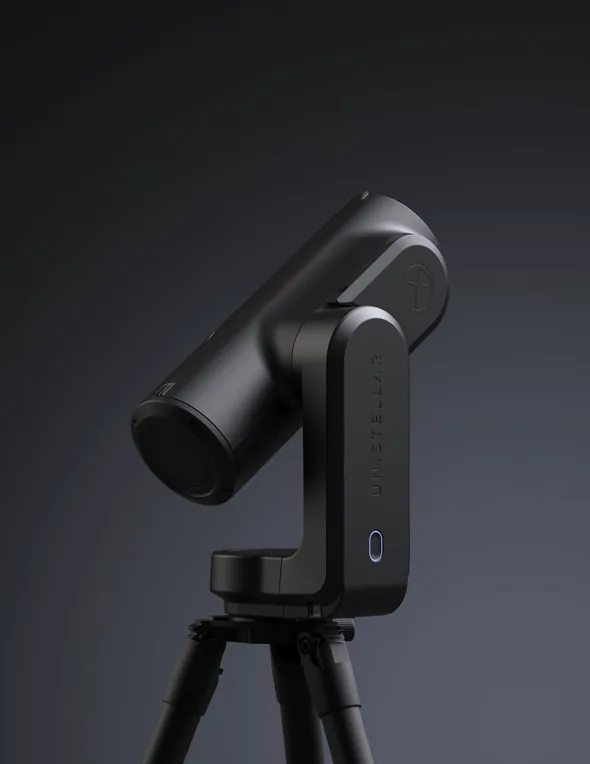
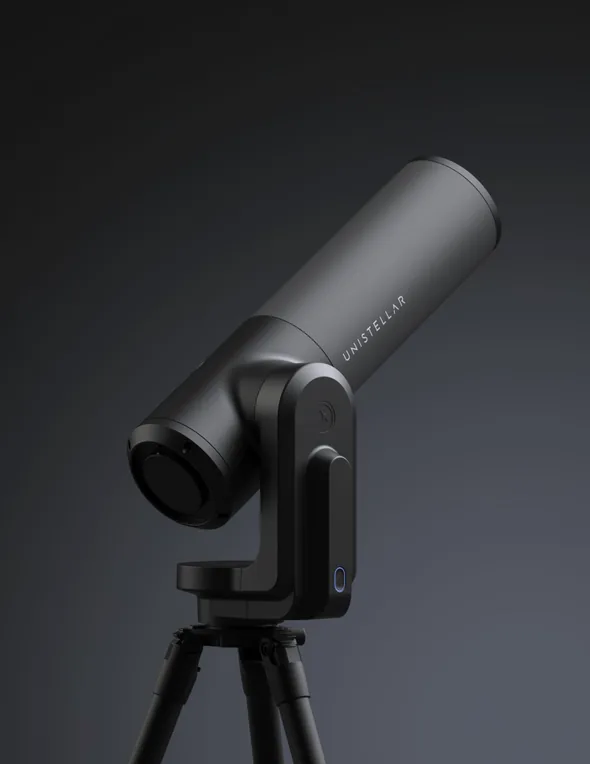
Unistellar lists no physical filter for the Unistellar Odyssey or the Unistellar eQuinox 2. It describes instead an automated model that filters noise and light pollution as the image is built. On this site that counts for 7 out of 10 in the ease score, where a physical dual-band filter counts for 10: software can flatten a gradient and reduce noise, but it cannot recover light that never separated from the glow. In return, Unistellar's 85 mm and 114 mm mirrors gather far more of a galaxy's light than any filtered refractor here, which is where processing has something to work with.
A drawer for your own filters
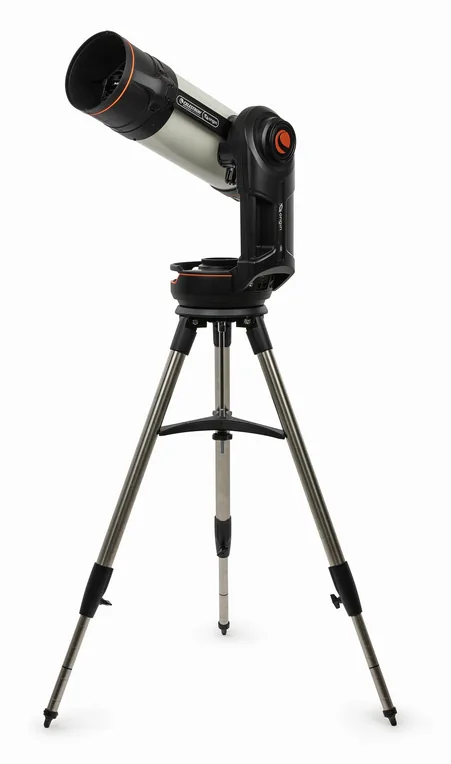
The Celestron Origin Mark II has an integrated drawer that takes standard 1.25 and 2 inch astronomy filters, so you choose the filter rather than the maker. Celestron does not list one as built in, which is why the For town skies label is not set on its page.
Where the Vaonis models stand
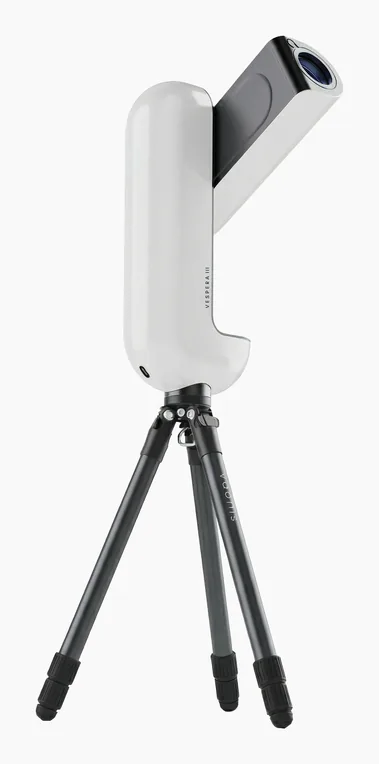
Vaonis lists no built-in light pollution filter in the specifications read for the Vespera III and its siblings, and no processing claim either, so the town skies label stays off them. Their strength under a bright sky lies elsewhere: the Vespera III's 15 multi-night slots let you build up total exposure over several evenings, which is the slow route through skyglow. The plain Seestar S30 is in the same position, with no filter listed by ZWO.
How this site scores it
Light pollution handling is one of the four parts of the ease score. A physical light pollution filter counts for 10, software processing for 7, and a maker who states neither leaves that part out rather than scoring it zero. The For town skies label goes on any telescope where the maker states one or the other. On the models here, that means all five Seestar Pro and DwarfLab telescopes with filters, and all four Unistellar telescopes with processing, but none of the Vaonis models, the plain S30 or the Origin.
A plan for a town garden
- Choose nebulae with strong hydrogen and oxygen lines for the filtered models: Orion, the Rosette, the Heart and Soul, the Veil.
- Keep galaxies for darker nights, or for the larger mirrors, and give them more stacking time.
- Shield the telescope from a nearby lamp; direct light into the tube is worse than general glow.
- Look high: the sky near the zenith is darker than the sky near the rooftops.
- Avoid the week either side of full Moon for faint targets, filter or not.
The short list for Bortle 7 and up
For nebulae from a bright town, the filtered refractors lead: the S30 Pro for wide fields, the S50 Pro for more light, the Dwarf 3 for weight and weather sealing. For a mixed diet with galaxies included, the Odyssey's 85 mm mirror and software processing keep more of what a filter would discard, at 4 kg and with a field under one degree. If you can drive out to a darker site now and then, the ranking by budget and sky shows what that freedom opens up.
The models in this field note
-
50 mm, 2.8 kg, Tele: 2.8° (Portrait); Wide: 63° (Portrait)
Good seeing6.4 / 10
£999Typical UK retail price, 23 October 2026
See it at Seestar (ZWO) -
30 mm, 1.65 kg, Tele: 4.6°; Wide: 63°
Clear night6.9 / 10
£649Typical UK retail price, 23 October 2026
See it at Seestar (ZWO) -
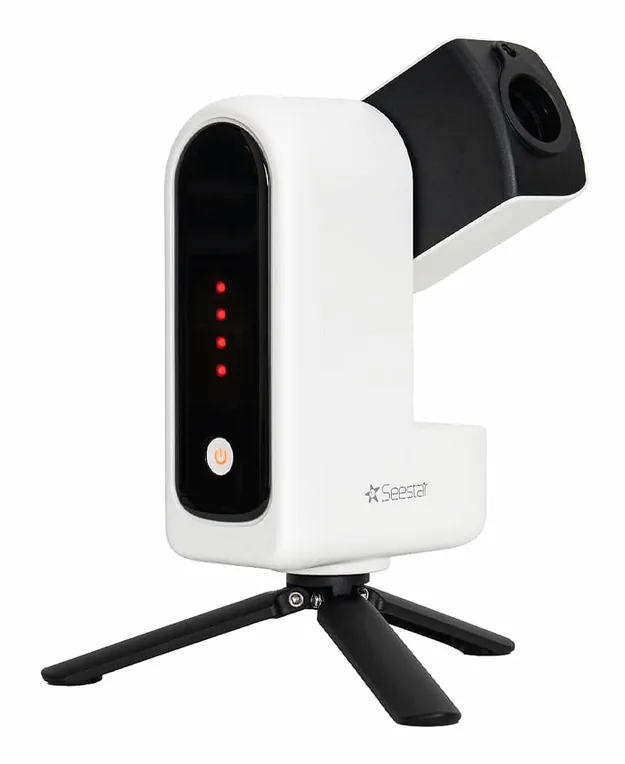
30 mm, 1.65 kg
£419Typical UK retail price, 23 October 2026
See it at Seestar (ZWO) -
35 mm, 1.35 kg, 3°
Clear night6.7 / 10
from £459Typical UK retail price, 23 October 2026
See it at DwarfLab -
30 mm, 0.84 kg
from £399Typical UK retail price, 23 October 2026
See it at DwarfLab -
90 mm, 5.5 kg
from £1,349Typical UK retail price, 23 October 2026
See it at DwarfLab -
85 mm, 4 kg, 0.75° × 0.56°
Good seeing5.9 / 10
£2,099Price at Unistellar's UK shop, 23 October 2026
See the price at Unistellar -
114 mm, 7 kg, 0.76° × 0.57°
Thin cloud5.2 / 10
£2,299Price at Unistellar's UK shop, 23 October 2026
See the price at Unistellar -
152 mm, 18.87 kg, 1.32° × 0.75°
Good seeing6.3 / 10
from £3,699Typical UK retail price, 23 October 2026
See it at Celestron -
50 mm, 5 kg, 2.5° × 1.4°
Good seeing6 / 10
£2,199Typical UK retail price, 23 October 2026
See it at Vaonis