Seestar S30 Pro or S50 Pro, and where the original S50 and S30 fit
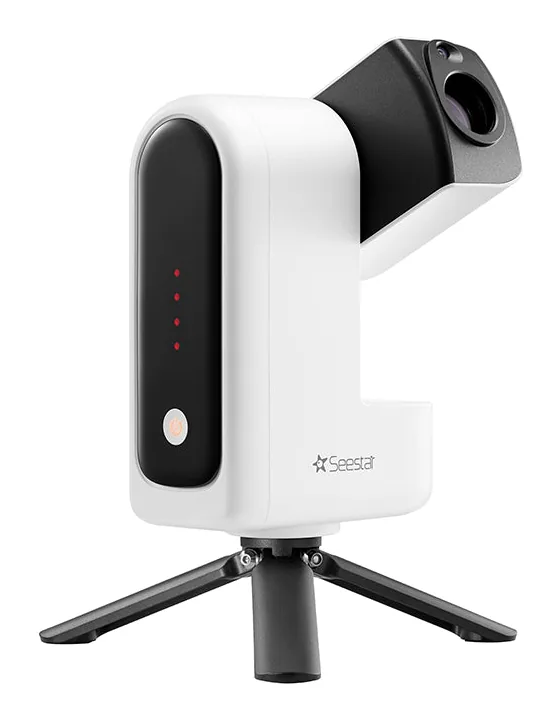
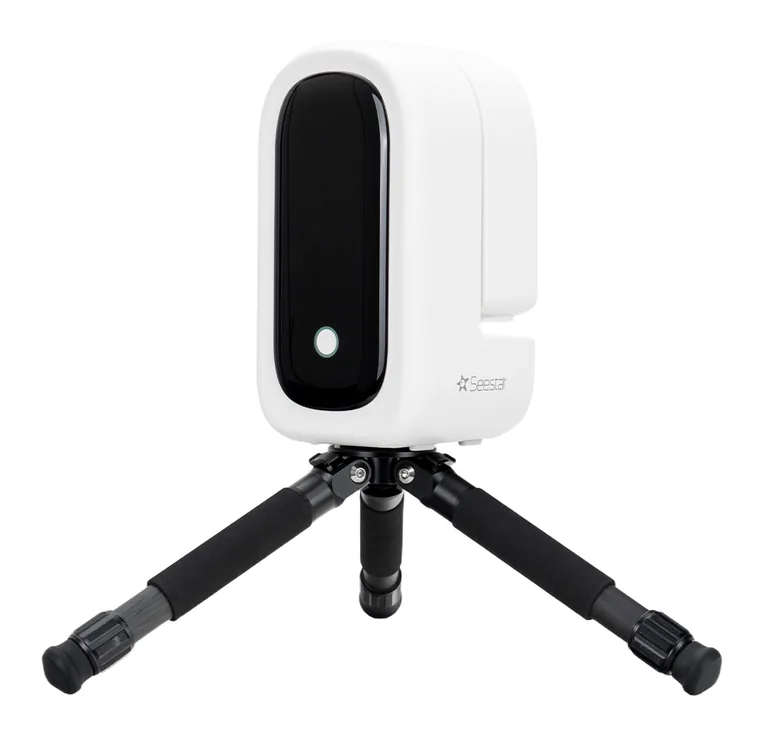
ZWO sells two Seestar Pro models that look like siblings and behave rather differently. One frames wide, the other gathers more light, and the numbers show exactly how far apart they are.
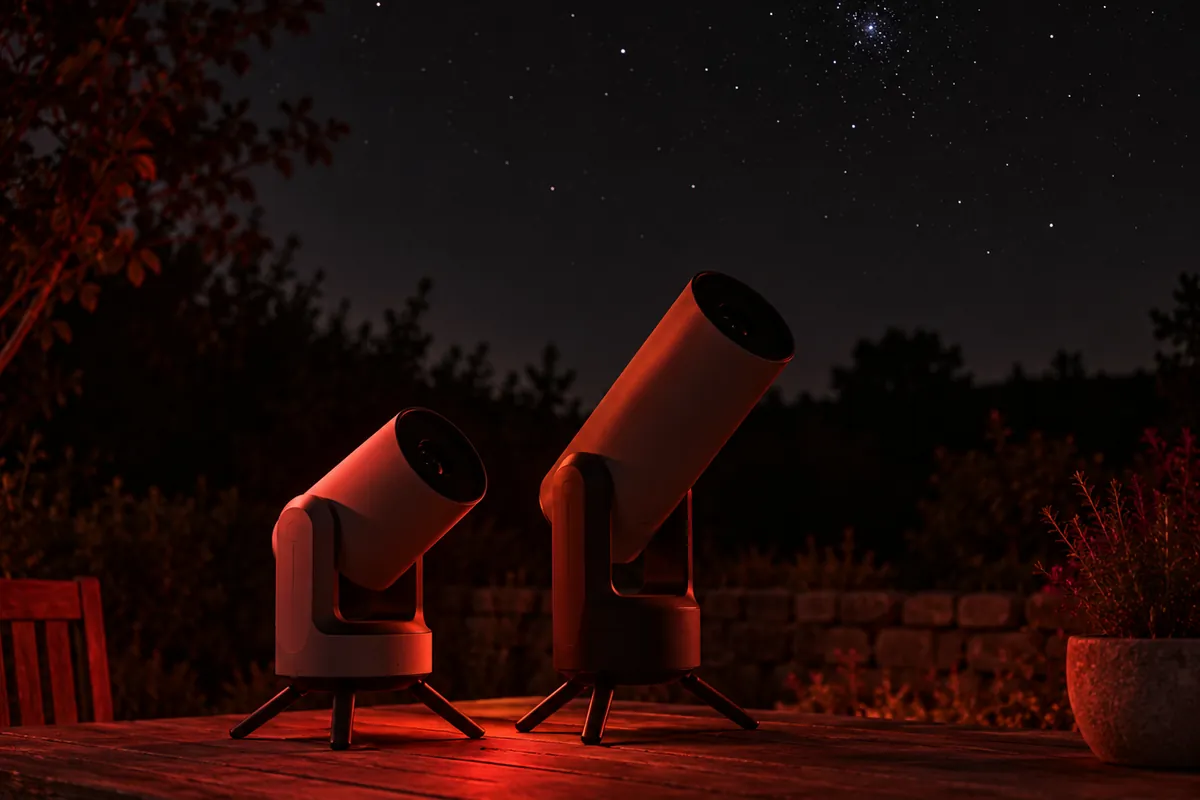
The two Pro models in figures
Both carry a UV/IR-cut filter, a dual-band filter for nebulae (OIII at 30 nm, H-alpha at 20 nm) and a dark-field filter for calibration. Both have a second, wide-angle camera with a 63° view for finding your way, and both offer an equatorial mode, which lets the mount follow the sky's rotation once it is tilted to the pole.
Aperture: what the extra 20 mm brings
A 50 mm lens collects close to three times the light of a 30 mm one, since the area grows with the square of the diameter. On this site that shows as a light grasp score of 4.4 for the S50 Pro against 1.9 for the S30 Pro. In a short British gap between clouds, more light per minute means a cleaner stack before the next bank rolls in. It is the single strongest reason to pick the larger model.
Field: what the smaller one keeps
The S30 Pro's shorter focal length spreads its frame over 4.6° of sky, enough to take in the whole of the Andromeda Galaxy or the North America Nebula in one image. The S50 Pro covers 2.8°, which suits the Orion Nebula or the Pleiades but leaves the largest targets for mosaics. That is why the S30 Pro scores 9.6 for field and the S50 Pro 7.5.
Detail and planets
The S50 Pro's 260 mm focal length and 2.9 µm pixels give a detail score of 4.2. ZWO does not give a pixel size for the S30 Pro's telephoto sensor, so its detail score is not worked out. Neither is a planetary instrument: at these focal lengths Jupiter and Saturn come out as small discs a couple of dozen pixels across. If planets matter to you, the guide to planets with a smart telescope sets out why focal length decides.
Carrying and running time
At 1.65 kg the S30 Pro is light enough to carry out with one hand and a flask in the other. The S50 Pro's 2.8 kg is still easy, and its nine hours of battery cover a long winter night, where the S30 Pro's six may need a power bank on the bench. Both keep the grab-and-go label on this site, which starts at 3 kg and under.
The plain S30 and the original S50
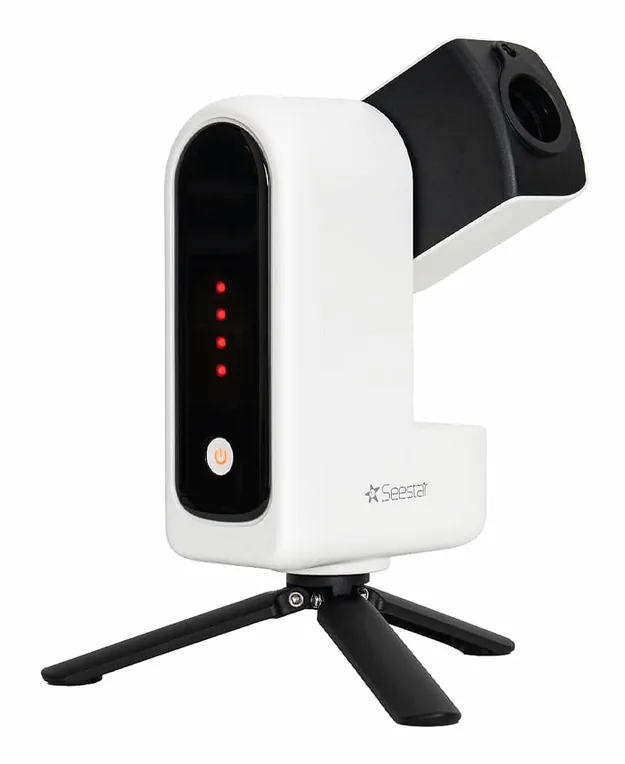
The Seestar S30 without the Pro suffix uses a Sony IMX662 sensor with a 1920 by 1080 frame and a 150 mm focal length. ZWO lists a 6000 mAh battery but no running time and no built-in light pollution filter in the specifications read for this site, so its ease and field scores stay empty and it carries no verdict. It shares the 1.65 kg body and the alt-azimuth mount.
The original Seestar S50, the model that made the format popular, has given way to the S50 Pro in ZWO's range and is no longer sold new, so it has no page here. If you come across one second-hand, the S50 Pro figures above are the ones to compare it against.
What the two share
Under the different lenses, ZWO builds the two Pro models on the same plan. Both carry a second, wide-angle camera with a 63° field, used to find targets and to frame the sky around them. Both list the same UV/IR-cut filter, the same dual-band filter for nebulae and a dark frame filter. Both offer an equatorial mode, both store to 128 GB, and both talk to the Seestar app over Wi-Fi, USB Type-C or Bluetooth, with a Wi-Fi range of about ten metres by ZWO's figure. Both record JPEG and FITS, plus MP4 or AVI video.
That shared base is why the choice between the S30 Pro and the S50 Pro rests almost entirely on aperture, field and weight. Nothing in the app or the filters tips it either way.
If neither fits
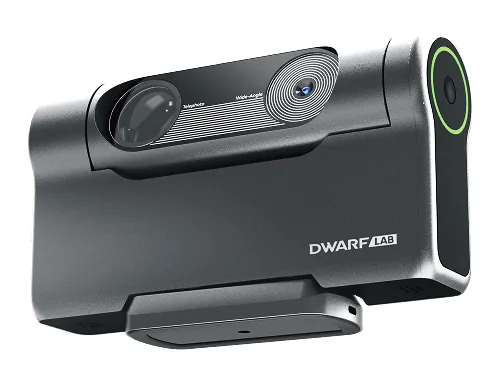
The Dwarf 3 offers a 3° field, 1.35 kg and an IP54 rating, a middle path between the two Seestars. For a large step in light grasp, the closest Unistellar models are the Unistellar Odyssey, with an 85 mm mirror, and the Unistellar eQuinox 2, with 114 mm. Both bring a field well under one degree and a weight above 4 kg, so they answer a different question: small, faint objects rather than wide nebulae.
In short
- Pick the S30 Pro for wide fields, the lightest carry and the Clear night verdict.
- Pick the S50 Pro for more light per minute and longer battery, at Good seeing.
- Pass over the plain S30 if a built-in nebula filter matters to you, as ZWO's specifications read here list none.
The models in this field note
-
30 mm, 1.65 kg, Tele: 4.6°; Wide: 63°
Clear night6.9 / 10
£649Typical UK retail price, 23 October 2026
See it at Seestar (ZWO) -
50 mm, 2.8 kg, Tele: 2.8° (Portrait); Wide: 63° (Portrait)
Good seeing6.4 / 10
£999Typical UK retail price, 23 October 2026
See it at Seestar (ZWO) -
30 mm, 1.65 kg
£419Typical UK retail price, 23 October 2026
See it at Seestar (ZWO) -
35 mm, 1.35 kg, 3°
Clear night6.7 / 10
from £459Typical UK retail price, 23 October 2026
See it at DwarfLab -
85 mm, 4 kg, 0.75° × 0.56°
Good seeing5.9 / 10
£2,099Price at Unistellar's UK shop, 23 October 2026
See the price at Unistellar -
114 mm, 7 kg, 0.76° × 0.57°
Thin cloud5.2 / 10
£2,299Price at Unistellar's UK shop, 23 October 2026
See the price at Unistellar