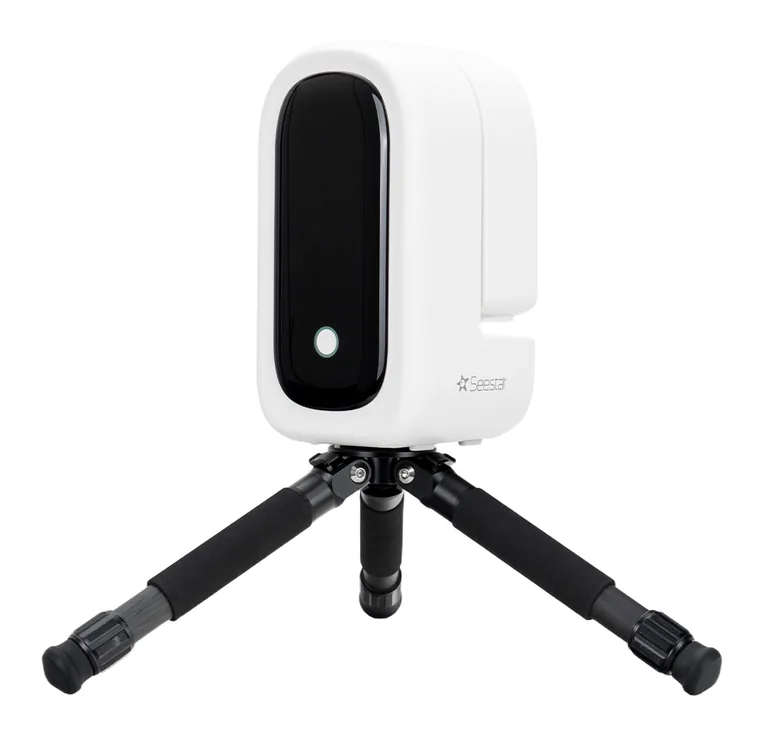
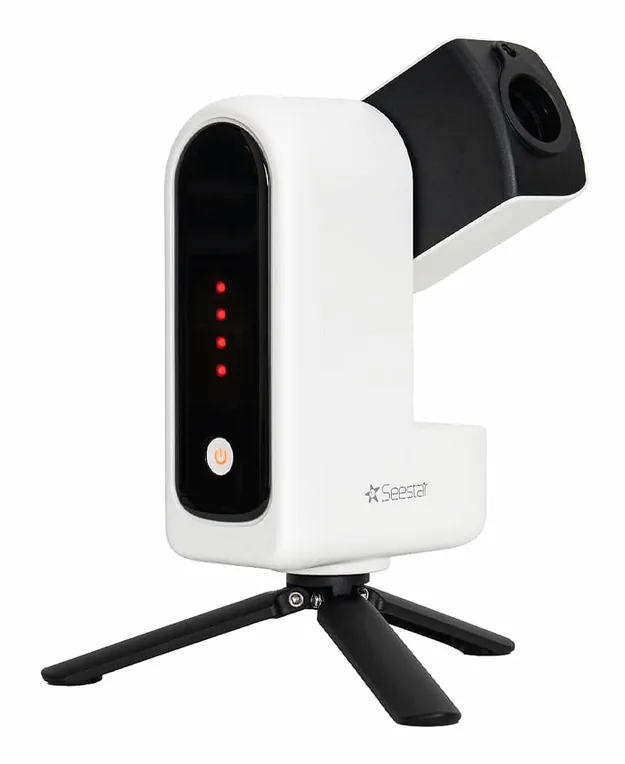
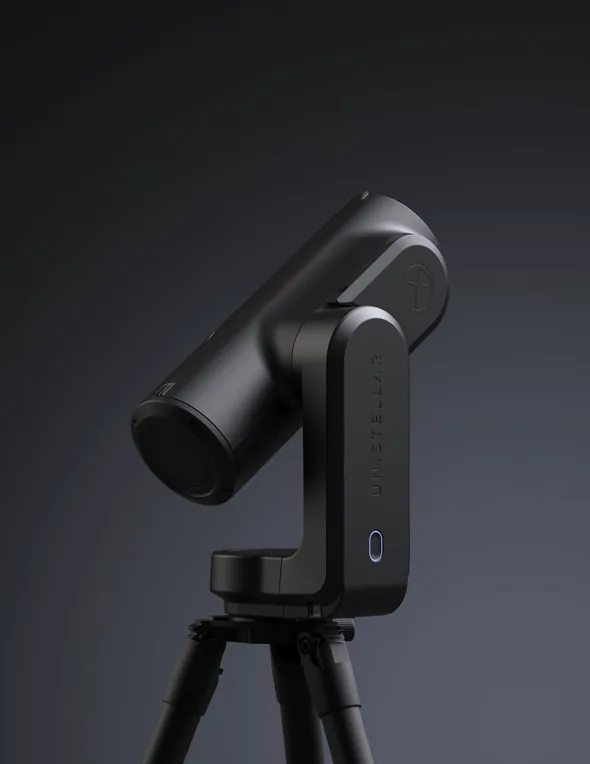
Dwarf 3, Dwarf mini or a Seestar: wide field against focal length
DwarfLab and ZWO make the two most compact families of smart telescope. Read side by side, their spec sheets show where they part ways, and also how much DwarfLab leaves unsaid.
The equivalent focal length puzzle
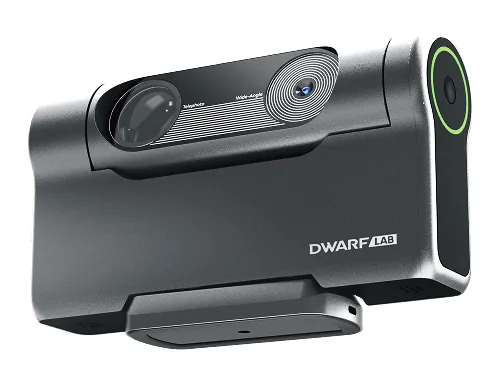
DwarfLab gives the Dwarf 3's telephoto lens as 35 mm of aperture with a 737 mm equivalent focal length, and the Dwarf mini's as 30 mm with a 1,016 mm full-frame equivalent. Those are camera figures, translated to what a lens would need on a full-frame sensor to give the same framing. They are not the physical focal length of the lens, which DwarfLab does not state for either model.
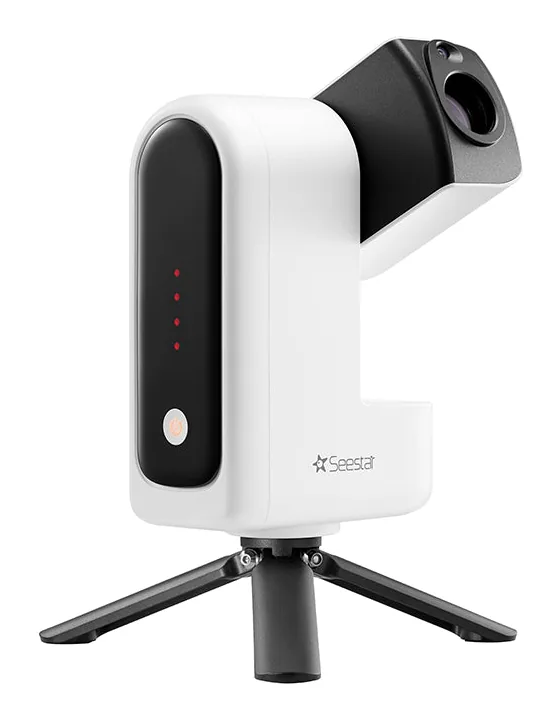
That matters, because the true focal length and the pixel size together set how fine a detail each pixel records. Without the first, the detail score on this site stays empty for both Dwarf models. ZWO, by contrast, lists 160 mm for the Seestar S30 Pro and 260 mm for the Seestar S50 Pro, so those two can be worked out.
Field of view
The Dwarf 3 frames a 3° field by DwarfLab's figure, giving it a field score of 7.8. That places it between the S50 Pro at 2.8° and the S30 Pro at 4.6°. The Dwarf mini has no stated field, so its score is blank. For large nebulae and star fields, the S30 Pro still has the widest single frame of the group.
Filters on board
- Dwarf 3: a visible-light filter, an astro filter and a dual-band filter for OIII and H-alpha.
- Dwarf mini: a dark-frame filter, an astro filter and a dual narrowband filter for the same two lines.
- Seestar S30 Pro and S50 Pro: a UV/IR-cut filter, a dual-band nebula filter and a dark-field filter.
- Seestar S30: no built-in light pollution filter in ZWO's specifications read for this site.
So every model here except the plain Seestar S30 carries a filter for emission nebulae from a bright sky. On that count the two families are level.
Weight and weather
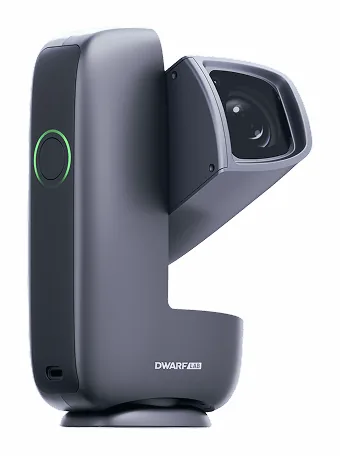
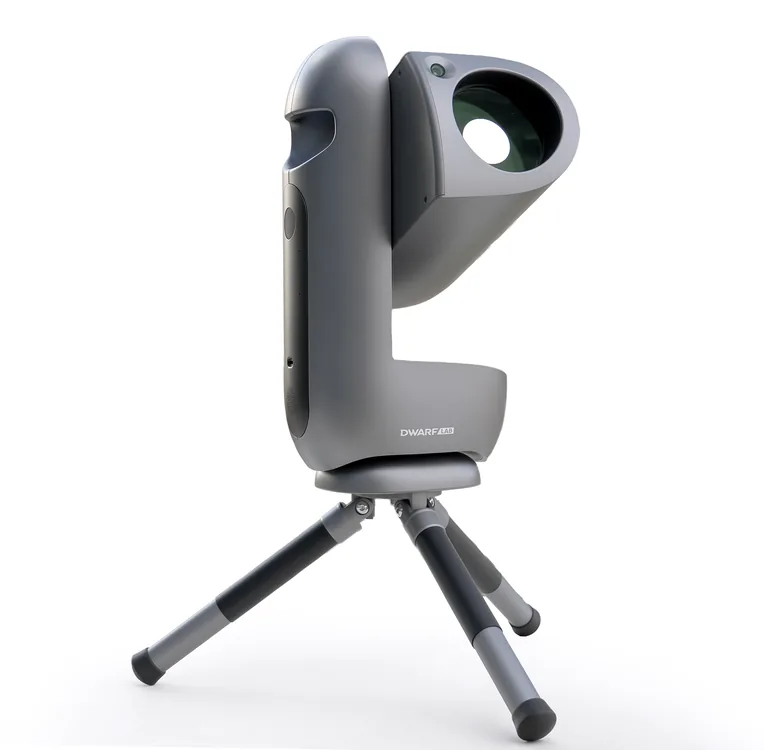
The Dwarf mini is the lightest telescope on this site at 840 g, and its portability score of 9.9 says so. The Dwarf 3 follows at about 1.35 kg, then the S30 Pro at 1.65 kg and the S50 Pro at 2.8 kg. The Dwarf 3 is also the only model here with an ingress rating, IP54, which DwarfLab lists against dust and splashing water. Under a British sky that line deserves a second look: dew and a passing shower are more common here than dust.
Running time and longer exposures
DwarfLab states five and a half hours of battery for the Dwarf 3 and does not state one for the Dwarf mini, so the mini has no ease score. ZWO lists six hours for the S30 Pro and nine for the S50 Pro. On exposure length, DwarfLab gives up to 60 seconds per frame for the Dwarf 3 and 90 seconds for the Dwarf mini in equatorial mode. All four of the Pro and Dwarf models offer an equatorial mode; the plain S30 is alt-azimuth only.
The Draco, a different animal
DwarfLab's larger DwarfLab Draco has 90 mm of aperture, a 5.5 kg body, autofocus and a choice of dual narrowband filters, including an SHO Edition with a sulphur and oxygen pair. Its light grasp score of 7.2 sits close to the Unistellar Odyssey. DwarfLab does not state its sensor, focal length or field, so the Draco carries no verdict here. It is a step into another weight class rather than a rival to the Dwarf 3.
Scores at a glance
Two cameras each
Both brands pair the main camera with a wide-angle one. On the Dwarf 3, DwarfLab lists a 2 MP wide-angle lens at a 45 mm equivalent focal length. ZWO's Seestar Pro models carry an 8.3 MP wide-angle camera with a 63° field. The wide camera helps locate targets and frame large areas such as a stretch of the Milky Way; the deep-sky images still come from the main lens.
Solar filters
DwarfLab packs a magnetic ND solar filter with the Dwarf 3. ZWO lists a magnetic solar filter as an external accessory for the Seestar S50 Pro and the Seestar S30 Pro. Observing the Sun requires the maker's solar filter.
How to choose between them
If weight is everything, the Dwarf mini is the one to look at, with the caveat that DwarfLab leaves out its field and battery life. If you want a rating against the weather and a field near 3°, the Dwarf 3 shares the Clear night verdict with the S30 Pro. If more light per minute matters more than either, the S50 Pro's 50 mm lens and nine-hour battery lead this group, in exchange for a narrower field and roughly double the weight of a Dwarf 3.
The models in this field note
-
35 mm, 1.35 kg, 3°
Clear night6.7 / 10
from £459Typical UK retail price, 23 October 2026
See it at DwarfLab -
30 mm, 0.84 kg
from £399Typical UK retail price, 23 October 2026
See it at DwarfLab -
90 mm, 5.5 kg
from £1,349Typical UK retail price, 23 October 2026
See it at DwarfLab -
30 mm, 1.65 kg, Tele: 4.6°; Wide: 63°
Clear night6.9 / 10
£649Typical UK retail price, 23 October 2026
See it at Seestar (ZWO) -
50 mm, 2.8 kg, Tele: 2.8° (Portrait); Wide: 63° (Portrait)
Good seeing6.4 / 10
£999Typical UK retail price, 23 October 2026
See it at Seestar (ZWO) -
30 mm, 1.65 kg
£419Typical UK retail price, 23 October 2026
See it at Seestar (ZWO) -
85 mm, 4 kg, 0.75° × 0.56°
Good seeing5.9 / 10
£2,099Price at Unistellar's UK shop, 23 October 2026
See the price at Unistellar