Seestar or Unistellar: what the extra aperture and money change
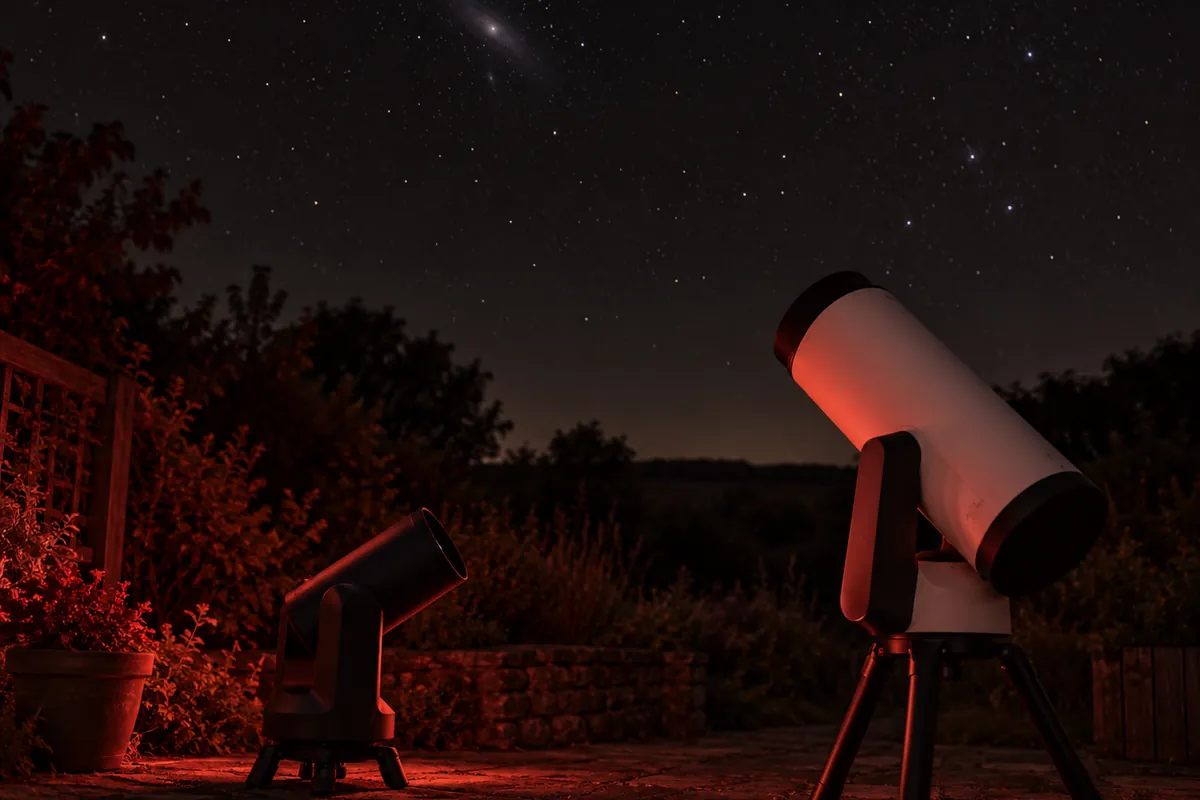
The Seestar and Unistellar ranges answer the same wish, a telescope that finds and photographs the sky for you, with opposite designs. One is a small lens with a wide view, the other a larger mirror with a narrow one.
Two designs, two answers
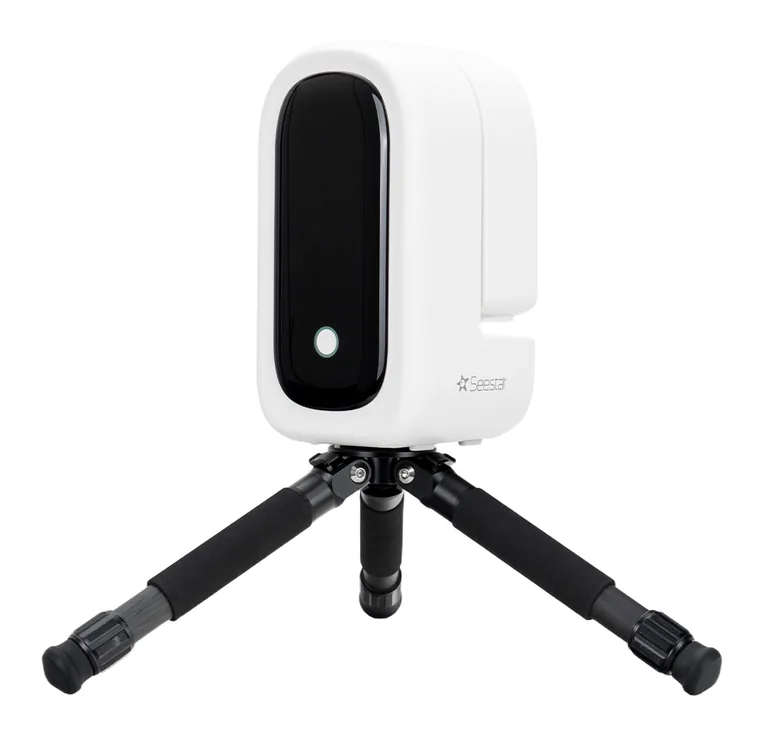
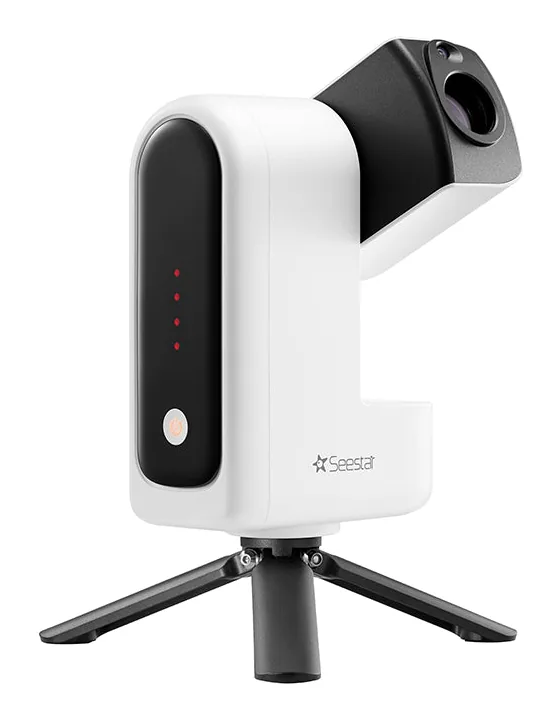
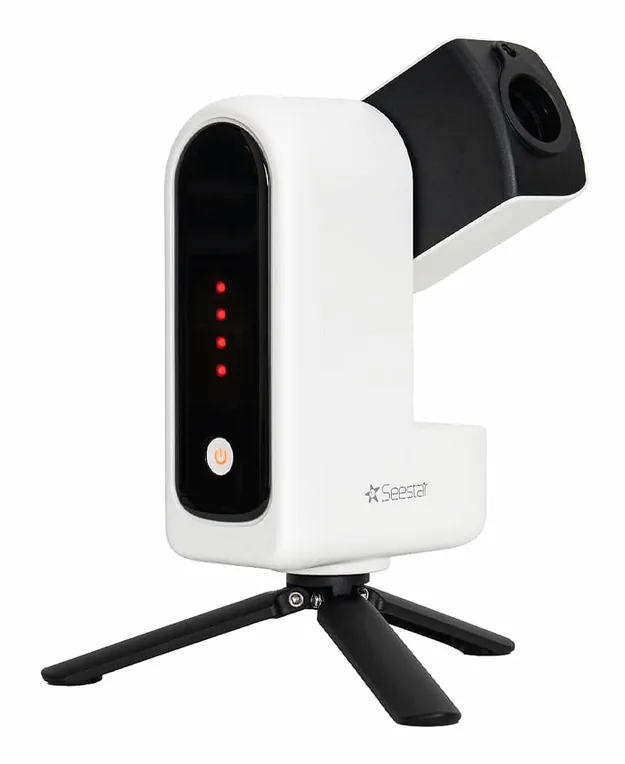
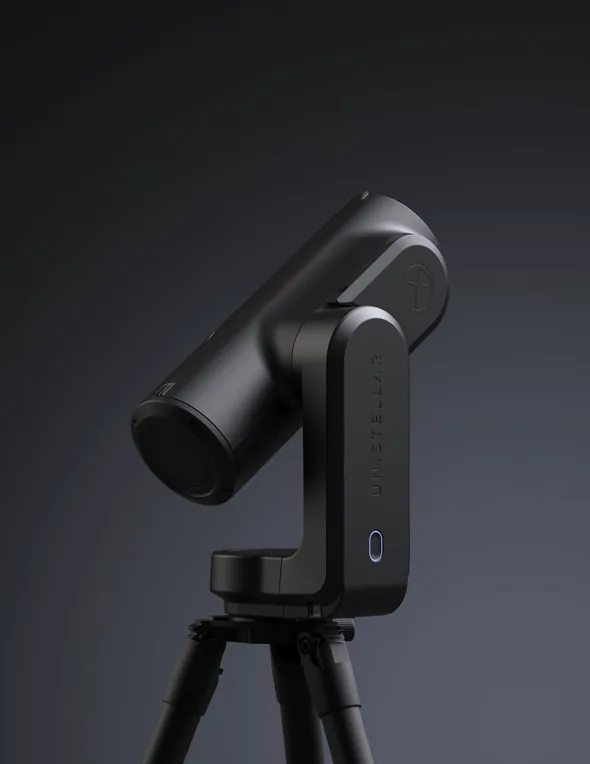
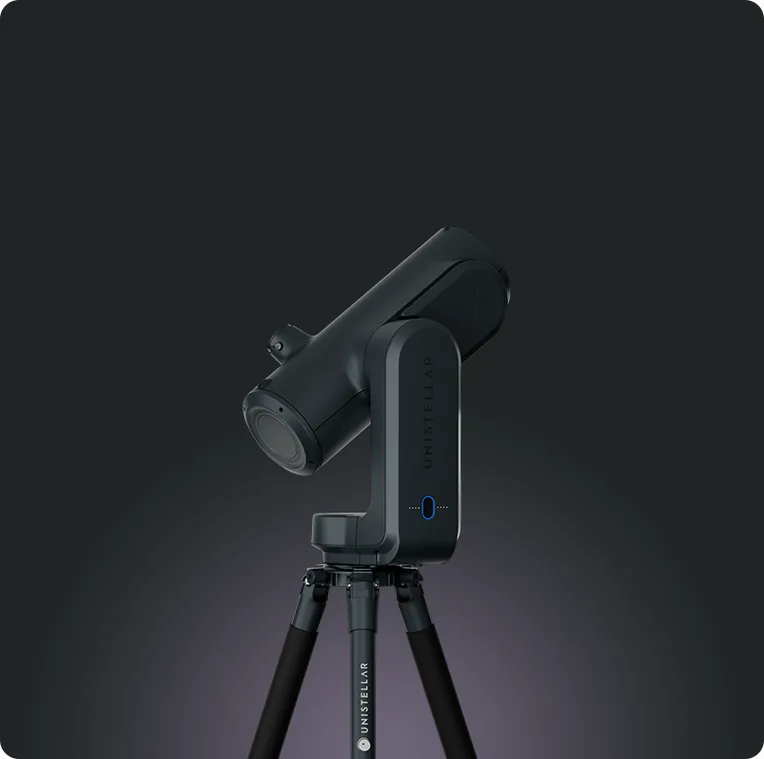
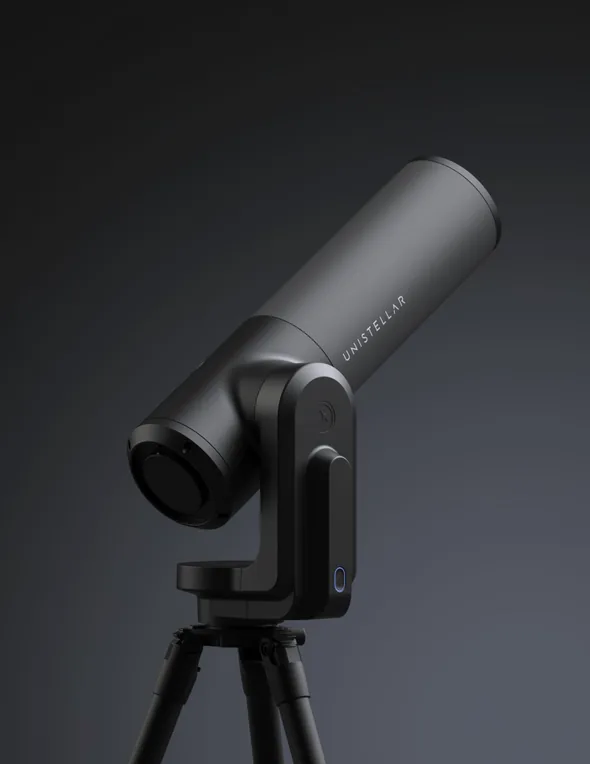
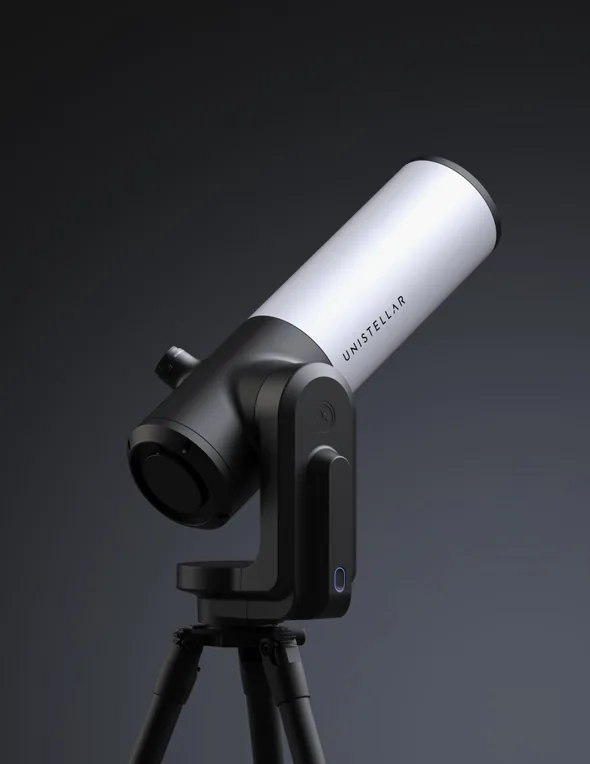
ZWO builds the Seestar around apochromatic refractors of 30 and 50 mm, with a sensor behind and a dual-band filter on a wheel. Unistellar builds around reflectors: an 85 mm mirror in the Odyssey and Odyssey Pro, a 114 mm mirror in the eQuinox 2 and eVscope 2. Everything else in the comparison follows from that difference in glass.
Does the larger mirror show more?
It gathers more. The Unistellar eQuinox 2 collects about five times the light of the Seestar S50 Pro, by the ratio of their areas. Unistellar quotes a limiting magnitude of 18.2 for its 114 mm models and 17.2 for the 85 mm ones; ZWO does not publish one for the Seestar. On this site the light grasp score reads 8.4 for the 114 mm Unistellars, 7.0 for the Odysseys and 4.4 for the S50 Pro.
What that means at the eyepiece, or on the phone, is a quicker climb out of the noise on small, faint targets: distant galaxies, compact planetary nebulae, globular clusters. Detail rises too. The Unistellar Odyssey pairs a 320 mm focal length with 1.45 µm pixels, and its detail score of 8.1 is the best on the site.
What the Seestar keeps
Field and weight. Unistellar quotes 34.2 by 45.6 arcminutes for the 114 mm models and 33.6 by 45 for the Odyssey pair, a little over half a degree on the short side. That is too tight for the Andromeda Galaxy, the Veil Nebula or the Heart Nebula, which overflow the frame. The Seestar S30 Pro covers 4.6° and the S50 Pro 2.8°. The field scores make the gap plain: 1.8 for every Unistellar telescope, 7.5 and 9.6 for the two Seestar Pros.
Weight follows the same line. Unistellar lists 7 kg for the eQuinox 2 and eVscope 2 before a 2 kg tripod, and 4 kg for the Odyssey before a 2.5 kg tripod. The S50 Pro weighs 2.8 kg and the S30 Pro 1.65 kg by ZWO's figures.
Town skies: filter or software
The Seestar Pro models carry a physical dual-band filter that passes the green and red light of emission nebulae and blocks most of the rest. Unistellar takes the other route, a processing model it describes as filtering light pollution and noise in software, with no physical filter listed. A dual-band filter does nothing for galaxies, whose light spreads across the spectrum, so neither approach is a cure; under a bright sky the filter has the edge on nebulae, and aperture keeps its edge on galaxies. The field note on town skies goes further.
Looking in rather than at a screen
Among the models listed here, only Unistellar states an electronic eyepiece, on the Unistellar eVscope 2 and the Unistellar Odyssey Pro. It shows the live image in a small display you look into, much like a conventional telescope. ZWO lists none for the Seestar range. If part of the pleasure for you is putting an eye to the instrument, that settles the matter.
Side by side
Budget bands
The Seestar range sits entirely in the entry band, the Odyssey and eQuinox 2 in the middle band, and the eVscope 2 and Odyssey Pro in the top band. The step from a Seestar to a Unistellar is therefore large, and what it buys is aperture, detail and, on two models, an eyepiece. What it gives up is field and lightness. The Seestar S30 sits below both Pro models and carries no verdict, as ZWO leaves out its battery life and field.
Setting up on a cold evening
Unistellar lists autofocus on the Odyssey and Odyssey Pro, but not on the eVscope 2 or the eQuinox 2, which do without it. ZWO does not state autofocus either way for the S50 Pro in the specifications read for this site. Battery figures run the other way from what you might expect: the eQuinox 2 leads at 11 hours, the S50 Pro and eVscope 2 give 9, the Odyssey 5. On a long winter night in the north of England, that difference decides whether you change a battery before midnight.
Which way to lean
- Lean Seestar if your targets are large nebulae, you observe from town, or the telescope must be carried far.
- Lean Unistellar if your targets are galaxies and small nebulae, you can reach a darker sky, and a few extra kilograms do not put you off.
- Lean towards an eyepiece model if looking in matters to you as much as the image.
The models in this field note
-
50 mm, 2.8 kg, Tele: 2.8° (Portrait); Wide: 63° (Portrait)
Good seeing6.4 / 10
£999Typical UK retail price, 23 October 2026
See it at Seestar (ZWO) -
30 mm, 1.65 kg, Tele: 4.6°; Wide: 63°
Clear night6.9 / 10
£649Typical UK retail price, 23 October 2026
See it at Seestar (ZWO) -
30 mm, 1.65 kg
£419Typical UK retail price, 23 October 2026
See it at Seestar (ZWO) -
85 mm, 4 kg, 0.75° × 0.56°
Good seeing5.9 / 10
£2,099Price at Unistellar's UK shop, 23 October 2026
See the price at Unistellar -
85 mm, 4 kg, 0.75° × 0.56°
Good seeing5.9 / 10
from £3,699Price at Unistellar's UK shop, 23 October 2026
See the price at Unistellar -
114 mm, 7 kg, 0.76° × 0.57°
Thin cloud5.2 / 10
£2,299Price at Unistellar's UK shop, 23 October 2026
See the price at Unistellar -
114 mm, 7 kg, 0.76° × 0.57°
Thin cloud5.1 / 10
£4,199Price at Unistellar's UK shop, 23 October 2026
See the price at Unistellar